In brief
Yes, by one of two routes, and not for every food. Shelf-stable foods on the California Department of Public Health’s (CDPH) approved list can be sold under a county cottage food registration (Class A) or permit (Class B). For cooked meals, CDPH’s pages describe one home route, a microenterprise home kitchen operation (MEHKO) health permit in a county or city that has authorized them.
- Class A is a registration for direct sales with no routine inspection; Class B is a permit issued after an inspection that adds sales through restaurants and food markets; one county’s registration or permit covers the whole state134.
- CDPH says that until a county or city authorizes MEHKOs, none can be issued a health permit there2.
- MEHKO limits: San Diego County (revised October 14, 2026) and Los Angeles County (May 1, 2025) state 30 meals a day and 90 a week; San Diego states $100,000 in gross annual sales adjusted annually for inflation, Los Angeles prints $100,000, and CDPH’s 2026 table gives $110,442; CDPH’s permit page still prints 60 a week and $50,00056713.
- CDPH says a MEHKO does not include a catering operation or a cottage food operation, and its approved list excludes baked goods with cream, custard or meat fillings58.
- The cottage food sales caps for 2026 are $88,878 for Class A and $177,756 for Class B, per CDPH’s table effective January 1, 20269.
This page explains what the city, county, state or agency publishes. It is not legal, tax or insurance advice, and this site is not a law firm, an accountancy or an insurance agency.
The detail
This page explains what CDPH and the counties publish. It is information, not legal advice; confirm the route, the fee and the limits with your county’s environmental health office before you apply.
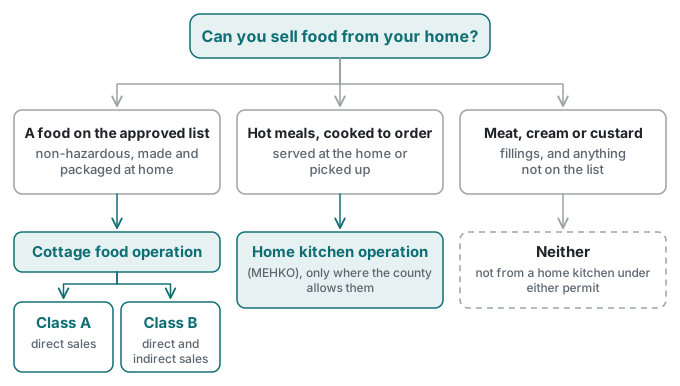
California has two legal ways to sell food made in a home kitchen, and they cover different foods. This page sorts them by what is being sold, then says what falls outside both. Each route has its own page: what a cottage food permit costs, county by county, Class A against Class B, the approved list, item by item and home restaurants (MEHKOs) by county. The cluster also covers the two other home businesses the state licenses outright: child care and a salon in the home.
The short answer
| If you want to sell… | The route | What it needs |
|---|---|---|
| Shelf-stable foods on CDPH’s approved list, direct to customers by any means | Cottage food, Class A | Registration with the county and a self-certification checklist; no routine inspection; gross sales up to $88,878 in 2026139 |
| The same foods, also through restaurants and food markets | Cottage food, Class B | A county permit issued after an inspection; no more than one inspection a year; gross sales up to $177,756 in 2026139 |
| Cooked meals, prepared and served the same day | Microenterprise home kitchen operation (MEHKO) | A health permit from a local environmental health agency whose county or city has authorized MEHKOs; an inspection; a food manager certification; 30 meals a day and 90 a week as the counties state it256 |
| Catering, and packaged foods the approved list excludes, such as baked goods with cream, custard or meat fillings | Neither | CDPH says a MEHKO is not a catering operation and not a cottage food operation5; the approved list excludes baked goods with cream, custard or meat fillings8 |
Route one: cottage food, for shelf-stable foods
CDPH’s own page says the department “does not permit or register Cottage Food Operations”; registration or a permit comes from the local environmental health department1. A Class A operation sells directly to the consumer, and a direct sale “may be fulfilled in person, via mail delivery, or using any other third-party delivery service”1. It registers with a self-certification checklist and under the Retail Food Code “shall not be subject to initial or routine inspections”3. A Class B operation may also sell indirectly “through restaurants and food markets”, must hold a permit before opening, and receives it after an initial inspection; after that it is “not subject to more than one inspection per year”13. Both are renewed annually, both require a cottage food operator training within three months of registration or permitting, and a registration or permit from one county is “sufficient for a cottage food operation to operate throughout the state”14.
What counts as a cottage food. The approved list, last reviewed April 2026, has ten categories: baked goods without cream, custard or meat fillings; candy and confections; extracts of at least 70 proof; dried, dehydrated and freeze-dried foods; frostings and icings without eggs, cream or cream cheese; honey and sorghum syrups; fruit butters, preserves and jams; nuts and nut butters; powdered beverage bases; and vinegars and mustards8. Pies appear as “fruit only, no pumpkin” and tamales as “fruit only”8. The item-by-item version is on the approved list page. A food outside the ten categories can be put to CDPH on a request form, CDPH 87641; until it is added, it is not a cottage food.
The caps. CDPH’s adjustment table puts the gross annual sales limits at $88,878 for Class A and $177,756 for Class B from January 1, 2026; the web page on the same site still prints $75,000 and $150,000, the 2022 base19. The Class A and Class B page works through the difference.
The fee. Each county sets its own. A Class A registration is $31 on Plumas County’s April 2026 UC Cooperative Extension sheet and $306 on Sacramento County’s page, which gives no schedule date; a Class B permit is $99 on the Plumas sheet and $528 on Sacramento’s page1011. The county table, with renewals and the date on each schedule, is on the cottage food cost page. Riverside, Santa Clara, Fresno, Kern and Marin counties are not in that comparison; their fees were not read.
Two county pages describe Class B indirect sales as limited to their own county; Los Angeles County’s says “within Los Angeles County”12, and Plumas County’s sheet describes product displayed in other businesses within Plumas County10. The state’s fact sheet says “throughout the state”4. The Class A and Class B page sets the two side by side.
Route two: a microenterprise home kitchen operation (MEHKO)
A MEHKO is, in the code’s words as CDPH prints them, a food facility “operated by a resident in a private home where food is stored, handled, and prepared for, and may be served to consumers”5. It was created by Assembly Bill 626, signed September 18, 2018, and the law took effect January 1, 20192. It is the route for cooked meals, which the cottage food list excludes: San Diego County’s FAQ says a MEHKO “is able to prepare and serve potentially hazardous foods” and can offer on-site dining, pick-up or delivery, while a cottage food operation is limited to prepackaged, non-potentially hazardous foods on the approved list6.
It exists only where a county or city says so. The law gives a city or county “full discretion” to authorize MEHKOs, and “until a county or a city authorizes these types of operations, MEHKOs will not be able to be issued a health permit to operate”2. CDPH links a PDF of environmental health agency websites but states no authorization status for any of them, and tells readers to contact their local environmental health agency214. San Diego County’s Board of Supervisors has authorized a permanent program countywide6; Los Angeles County runs a program under its own ordinance and reported 100 permits issued by May 1, 20257. The county-by-county list, with the date on each source, is on the MEHKO page.
What the permit requires, per CDPH. A permit application to the local environmental health agency; an inspection of the facilities; an approved food manager certification; sales directly between the MEHKO and the customer; food prepared, cooked and served the same day5. San Diego County adds that the MEHKO must be in the operator’s primary residence, that second homes, vacation homes and motor homes do not qualify, that a cottage food operation and a MEHKO cannot be run in the same residence, and that a MEHKO may have one full-time-equivalent employee who is not a household or family member6.
Sources disagree CDPH’s “General Permit Requirements for MEHKOs” page says “Only 30 meals per day, or a total of 60 meals per week is allowed” and sets gross annual sales limits of $50,0005. San Diego County’s FAQ, revised October 14, 2026, says preparation is limited to 30 meals per day or 90 per week and gross annual sales of $100,000 as adjusted annually for inflation6, and Los Angeles County’s May 1, 2025 release says 30 a day, 90 a week and $100,000 without mentioning the adjustment7. CDPH’s own adjustment table shows the reset to $100,000 on July 21, 2023 under Assembly Bill 1325 and $110,442 from January 1, 202613. The two counties agree on the meal counts, and the department’s table agrees on the $100,000 base. The county that issues the permit states the limit that applies to it, so that is the figure to plan around.
The fee. Los Angeles County’s May 1, 2025 release gives a $597 application review fee and describes a one-time county subsidy waiving it for up to 1,000 operators7. The county’s pages disagree on the waiver’s end date; the MEHKO page sets out both. San Diego County’s FAQ says an initial health permit fee is paid with the application and an annual permit fee each year after, and points to its fee schedule without printing a figure6.
Route three: neither
Some foods fit neither route, and the sources state this in few words.
- Catering. CDPH’s page says a MEHKO “does not include” a catering operation as defined in Health and Safety Code section 113739.1, or a cottage food operation as defined in section 113758; San Diego County’s FAQ repeats both exclusions56. CDPH’s pages and San Diego County’s FAQ describe no home route for catering and say nothing more about it.
- Baked goods with cream, custard or meat fillings. The first approved category is baked goods “without cream, custard, or meat fillings”8. In a county that has authorized MEHKOs, a cooked meal that includes such food is a MEHKO question, not a cottage food one6.
- Pickled vegetables. The word “pickle” does not appear on the approved list; the preserves category covers fruit butters, preserves, jams and jellies, and states “additional fruits or vegetables will not be approved”8.
- Any food not on the list. Not a cottage food until CDPH adds it18.
The city and county layer
For cottage food only, Government Code section 51035 says a city or county “shall not prohibit a cottage food operation” in a residence, but lets the local government require a permit to use the residence under reasonable standards on spacing, traffic, parking and noise, or treat the operation as a permitted residential use; on request it must give a list of the permits and fees required15. In San Diego County’s Class B packet, an applicant in an incorporated city needs a city business license whose address “must match your primary residence”, and an applicant in an unincorporated area needs a Planning and Development Services stamp approving the use of the home16. For a MEHKO, the same county’s FAQ says a person “must check their lease agreement” for restrictions on a home business and advises checking with an HOA before applying6.
Those steps are covered on home occupation permits in California, business licenses for a home business, running a business from a rented home and HOA rules and the home business.
The sales tax note
CDTFA’s home-based business guide says sales of hot food are generally taxable and sales of cold food to go are not, but that tax does apply to hot or cold food sold to be eaten on the business premises, at tables, chairs or counters, or at an event where admission is charged17. For home bakeries, it says baked goods such as bread, cookies and cakes are generally not taxable when sold to go or for resale, and are taxable when sold for consumption at the home-based business location, with a cake tasting fee as its example17. A seller’s permit is free18; who needs one is on the seller’s permit page. CDTFA’s guide does not address how these food rules apply to a MEHKO’s meals.
When to get help
The county environmental health office is the first call: it issues the registration or permit, states the fee and, under Government Code section 51035, must give the breakdown of local permits and fees on request15. CDPH’s Food and Drug Branch answers questions about the approved list and the training at (800) 495-3232 or [email protected]19. Whether the home may be used for the business is the city planning department’s question. A reason to go further is a fee that differs from the county’s published schedule, an inspection finding, or a county that has not said whether it allows MEHKOs; the paid routes are a food-business attorney or a permit consultant.
Frequently Asked Questions
Can I legally sell food I make at home in California?
What can you sell with a cottage food license in California?
Foods in the ten categories on CDPH’s approved list, reviewed April 2026, such as baked goods without cream, custard or meat fillings, candy, jams, honey, nuts, dried foods and vinegars and mustards8.
Do I need a license to sell food from home in California?
How much is a cottage food permit in California?
What is a MEHKO in California?
How much is a MEHKO permit in California?
Los Angeles County’s May 1, 2025 release lists a $597 application review fee and describes a one-time subsidy waiving it for up to 1,000 operators; the county’s pages disagree on the end date, set out on the MEHKO page. San Diego County points to its fee schedule without printing a figure67.
Which counties allow a MEHKO?
How many meals can a MEHKO sell?
Related Articles
Sources (18)
- Cottage Food Operations — California Department of Public Health. Accessed 2026-10-26.
- Microenterprise Home Kitchen Operations — California Department of Public Health. Accessed 2026-10-26.
- California Health and Safety Code section 114365 — Public.Law mirror of the California Retail Food Code. Accessed 2026-10-26.
- Assembly Bill (AB) 1144 Fact Sheet — California Department of Public Health. Accessed 2026-10-26.
- General Permit Requirements for Microenterprise Home Kitchen Operations — California Department of Public Health. Accessed 2026-10-26.
- Microenterprise Home Kitchen Operation (MEHKO) FAQs, Rev. 10/14/2026 — County of San Diego Department of Environmental Health and Quality. Accessed 2026-10-26.
- LA County Microenterprise Home Kitchen Operation Program Gains Momentum With 100 Permits Issued and More to Come — County of Los Angeles, May 1, 2025. Accessed 2026-10-26.
- Approved Cottage Foods — California Department of Public Health, document last reviewed April 2026. Accessed 2026-10-26.
- Cottage Food Operation Adjusted Gross Annual Sales Limit (2026) — California Department of Public Health, Food and Drug Branch. Accessed 2026-10-26.
- Cottage Food License (April 2026) — University of California Cooperative Extension, Plumas-Sierra. Accessed 2026-10-26.
- Cottage Food Operation — Sacramento County Environmental Management Department. Accessed 2026-10-26.
- Class B Cottage Food Operators — Los Angeles County Department of Public Health, Environmental Health. Accessed 2026-10-26.
- Microenterprise Home Kitchen Operation Adjusted Gross Annual Sales Limit (2026) — California Department of Public Health, Food and Drug Branch. Accessed 2026-10-26.
- Environmental Health Agency Link to MEHKO Ordinance/Resolution — California Department of Public Health. Accessed 2026-10-26.
- California Government Code section 51035 — Public.Law mirror. Accessed 2026-10-26.
- Class B Cottage Food Operation Application Packet — County of San Diego Department of Environmental Health and Quality, revised 09/09/2026. Accessed 2026-10-26.
- Home-Based Businesses: Industry Topics — California Department of Tax and Fee Administration. Accessed 2026-10-26.
- Publication 73, Your California Seller’s Permit — California Department of Tax and Fee Administration, October 2026. Accessed 2026-10-26.